Jasper's Death in the Mountains
The Dog StarsJasper’s death in the mountains ends a shared fishing journey and leaves Hig to continue alone. The loss is discovered not in a confrontation or sudden attack, but at a familiar camp after a hard walk and a night in the open. Hig’s belated recognition of Jasper’s weakness gives the death its particular weight: the trip had seemed ordinary until its routines became the setting for a final separation.
Background and the Mountain Journey
Jasper is Hig’s dog and closest companion in a life organized around vigilance and survival. Hig regards him as an essential alarm, but their bond extends well beyond practical protection: he calls Jasper his little brother and his heart. Their mountain journeys also preserve a kind of life that survival duties cannot provide. Hig goes into the woods to fish and to be away from the defensive routines he shares with Bangley; the living forest and running water offer a connection to a world that has not entirely vanished.
The journey takes place against accumulating signs of environmental change. By mid-April, old seasonal expectations have become unreliable, and Hig remembers winters when the peaks held little snow. He fears this more than attacks or disease. Trout have disappeared from warming streams, and the loss of the creek itself would be worse. Hig still fishes in mountain water, adapting to the species that remain, while cherishing the possibility of finding a stream and forest that are recovering. The journey with Jasper therefore carries both practical purpose and the memory of what the landscape used to sustain.
The Last Fishing Trip
On the walk upstream, Jasper is stiff in the hips and short of breath. It is his first long walk of the year, and Hig attributes the difficulty in part to being out of shape after winter. The pair cross an old highway by way of a dry culvert and continue beside the creek. Though wolf tracks briefly draw Jasper’s attention, he soon seems more occupied with keeping up. Hig notices his difficulty but does not yet understand it as a warning that the dog is near the end of his life.
Hig fishes through the afternoon and catches several carp. By the time he stops, he has been wading for hours, and the cold water and fading daylight make it time to camp. Jasper has revived after eating fish and watches Hig as they settle near a familiar fire pit on a sandy bar. They spend the night beneath a large tree. Hig moves the tarp aside so he can sleep looking at the sky, accepting that the bedding may collect dew and expecting to dry it by the fire in the morning. The decision belongs to an ordinary night outdoors; its consequence is only clear when morning comes.
Discovery and Grief
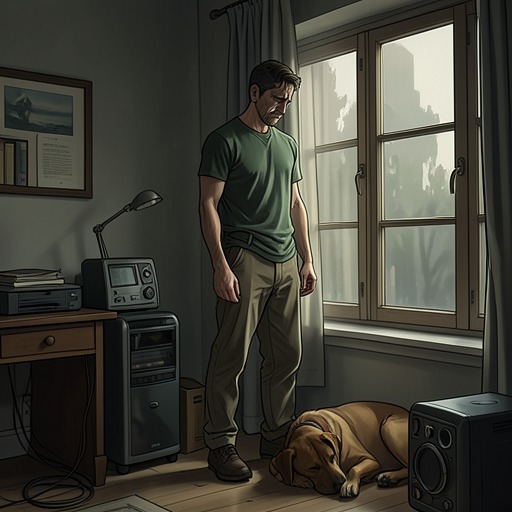
At dawn, Hig wakes to find the sleeping bag and Jasper covered in frost. Jasper does not move when Hig tries to cover him with the dog’s quilt. When Hig touches his ear and checks his muzzle and eyes, he understands that Jasper has died. The previous day’s stiffness and short breathing return to him as missed signs. His grief arrives with the recognition that he should have noticed how much trouble Jasper was having on the walk.
Hig pulls Jasper closer and lies beside him beneath the quilt. He cannot immediately turn to the next task of making a fire. The contrast between the routine he expected—warmth, breakfast, and continuing the trip—and the stillness he has found marks the point at which this outing becomes a vigil. On the third day, Hig wakes with a brief expectation that Jasper might stir, then remembers that he is dead. The return of that expectation shows how difficult it is for ordinary habit to catch up with loss.
Burial and Continuing Alone
Hig carries Jasper, still curled in the quilt, beneath the trees and digs a grave with a stick, a flat rock, and his hands. He chooses one of their favorite camps, a place they had visited year after year, beside the creek whose changing seasons had been part of their life together. The familiar setting gives the burial a continuing connection to their shared outings: Jasper is left where the water and the woods can remain part of his remembered world.
After covering the grave, Hig gathers smooth stones from the stream and builds a mound as high as his chest. He lays his old wool sweater over the top, joining his own familiar clothing with the place where he has left Jasper. The gesture makes the marker personal without making it permanent in any ordinary sense: he imagines the scents of both of them dispersing with the seasons. When the burial is finished, Hig loads the sled and walks upstream. During the day, he repeatedly stops and turns as if to call Jasper to keep up, then resumes the journey alone.
Ecological Loss and the Shape of the Event
Jasper’s death stands beside, but is not merely a symbol for, the ecological losses Hig mourns. Before the trip, the disappearance of trout had been the loss that could bring him to tears. Later, he reflects on trout, elk, tigers, elephants, suckers, and even carp being gone. These losses arise over time through changing conditions, including warmer water and diminished snow, rather than through one visible catastrophe. Hig’s grief for Jasper is distinct, grounded in their daily companionship, yet it unfolds in a landscape where other forms of life are also disappearing.
The narrative makes the separation tangible through the details of their shared routine: the walk, the fish, the familiar camp, the quilt, and the repeated backward glances after the burial. What had served as comfort and continuity—the mountain journey they made together—becomes the place where Hig must acknowledge that Jasper cannot follow. The creek remains, but the companion who traveled beside him is gone; Hig’s decision to walk on carries both the fact of that absence and the habits of their life together.